Experimental Hybrid Cars Get Up to 250 Mpg
By TIM MOLLOY, Associated Press Writer
Sat Aug 13, 7:08 PM ET
Politicians and automakers say a car that can both reduce greenhouse gases and free America from its reliance on foreign oil is years or even decades away. Ron Gremban says such a car is parked in his garage.
It looks like a typical Toyota Prius hybrid, but in the trunk sits an 80-miles-per-gallon secret — a stack of 18 brick-sized batteries that boosts the car's high mileage with an extra electrical charge so it can burn even less fuel.
Gremban, an electrical engineer and committed environmentalist, spent several months and $3,000 tinkering with his car.
Like all hybrids, his Prius increases fuel efficiency by harnessing small amounts of electricity generated during braking and coasting. The extra batteries let him store extra power by plugging the car into a wall outlet at his home in this San Francisco suburb — all for about a quarter.
He's part of a small but growing movement. "Plug-in" hybrids aren't yet cost-efficient, but some of the dozen known experimental models have gotten up to 250 mpg.
They have support not only from environmentalists but also from conservative foreign policy hawks who insist Americans fuel terrorism through their gas guzzling.
And while the technology has existed for three decades, automakers are beginning to take notice, too.
So far, DaimlerChrysler AG is the only company that has committed to building its own plug-in hybrids, quietly pledging to make up to 40 vans for U.S. companies. But Toyota Motor Corp. officials who initially frowned on people altering their cars now say they may be able to learn from them.
"They're like the hot rodders of yesterday who did everything to soup up their cars. It was all about horsepower and bling-bling, lots of chrome and accessories," said Cindy Knight, a Toyota spokeswoman. "Maybe the hot rodders of tomorrow are the people who want to get in there and see what they can do about increasing fuel economy."
The extra batteries let Gremban drive for 20 miles with a 50-50 mix of gas and electricity. Even after the car runs out of power from the batteries and switches to the standard hybrid mode, it gets the typical Prius fuel efficiency of around 45 mpg. As long as Gremban doesn't drive too far in a day, he says, he gets 80 mpg.
"The value of plug-in hybrids is they can dramatically reduce gasoline usage for the first few miles every day," Gremban said. "The average for people's usage of a car is somewhere around 30 to 40 miles per day. During that kind of driving, the plug-in hybrid can make a dramatic difference."
Backers of plug-in hybrids acknowledge that the electricity to boost their cars generally comes from fossil fuels that create greenhouse gases, but they say that process still produces far less pollution than oil. They also note that electricity could be generated cleanly from solar power.
Gremban rigged his car to promote the nonprofit CalCars Initiative, a San Francisco Bay area-based volunteer effort that argues automakers could mass produce plug-in hybrids at a reasonable price.
But Toyota and other car companies say they are worried about the cost, convenience and safety of plug-in hybrids — and note that consumers haven't embraced all-electric cars because of the inconvenience of recharging them like giant cell phones.
Automakers have spent millions of dollars telling motorists that hybrids don't need to be plugged in, and don't want to confuse the message.
Nonetheless, plug-in hybrids are starting to get the backing of prominent hawks like former CIA director James Woolsey and Frank Gaffney, President Reagan's undersecretary of defense. They have joined Set America Free, a group that wants the government to spend $12 billion over four years on plug-in hybrids, alternative fuels and other measures to reduce foreign oil dependence.
Gaffney, who heads the Washington, D.C.-based Center for Security Policy, said Americans would embrace plug-ins if they understood arguments from him and others who say gasoline contributes to oil-rich Middle Eastern governments that support terrorism.
"The more we are consuming oil that either comes from places that are bent on our destruction or helping those who are ... the more we are enabling those who are trying to kill us," Gaffney said.
DaimlerChrysler spokesman Nick Cappa said plug-in hybrids are ideal for companies with fleets of vehicles that can be recharged at a central location at night. He declined to name the companies buying the vehicles and said he did not know the vehicles' mileage or cost, or when they would be available.
Others are modifying hybrids, too.
Monrovia-based Energy CS has converted two Priuses to get up to 230 mpg by using powerful lithium ion batteries. It is forming a new company, EDrive Systems, that will convert hybrids to plug-ins for about $12,000 starting next year, company vice president Greg Hanssen said.
University of California, Davis engineering professor Andy Frank built a plug-in hybrid from the ground up in 1972 and has since built seven others, one of which gets up to 250 mpg. They were converted from non-hybrids, including a Ford Taurus and Chevrolet Suburban.
Frank has spent $150,000 to $250,000 in research costs on each car, but believes automakers could mass-produce them by adding just $6,000 to each vehicle's price tag.
Instead, Frank said, automakers promise hydrogen-powered vehicles hailed by President Bush and Gov. Arnold Schwarzenegger, even though hydrogen's backers acknowledge the cars won't be widely available for years and would require a vast infrastructure of new fueling stations.
"They'd rather work on something that won't be in their lifetime, and that's this hydrogen economy stuff," Frank said. "They pick this kind of target to get the public off their back, essentially."
___
On the Net:
CalCars Initiative: http://calcars.org
Sunday, August 14, 2005


Saturday, August 13, 2005


JUST BEFORE IT ROLLED OVER AND DUMPED ABOUT A HALF INCH OF RAIN AND SOME FANTASTIC LIGHTNING, AND SOME STRONG WIND.. NOTICE THE AWESOME DARK CLOUDS UP ON TOP.. HEHE.. LIGHTNING HIT JUST AS I SNAPPED THIS, AND I STEPPED INSIDE.. RATHER SCARED.. HATE TO ADMIT IT.. BUT IT MADE THE HAIR ON MY BACK STAND UP!!


HAPPY BIRTHDAY AUNT FREDA AND COUSIN DORIS.. AUGUST 15 AND 16TH!!

Aunt Freda was the guest of honor, and it was also Cousin Doris's birthday the day after Aunt Freda's too.. so it was a big party for all!! Joanna and Clinton, Doris and Jim, Aunt Freda and Uncle Ivan, Aunt Fanny, Mom and Mk, Phil and Tammy and Austyn, Paul and Heather and Madison, and Andrew, Ann and I, Jonathan and Randi and Kaitlyn were in attendance... What a great time, and some wonderful visits, and we missed some family... but there will be another time, I am sure. How lucky we are to be in a world where we can come and go as we please, do what we want, when we want, get what we want when we want.. and visit those we can, when we can! The food was great, the company was awesome.. and it was fantastic!! Aunt Fannie was telling me about some "going's on" at the Senior Citzens Center in El Reno... Aunt Freda was talking about 17 years of donuts and day old donuts... and having family over for ice cream, and Clinton's back is a bit better, Mom is not doing to well, and on and on... it was truly God's blessing to us to be able to share that wonderful time together! Thanks to everyone who came and made it a special night!
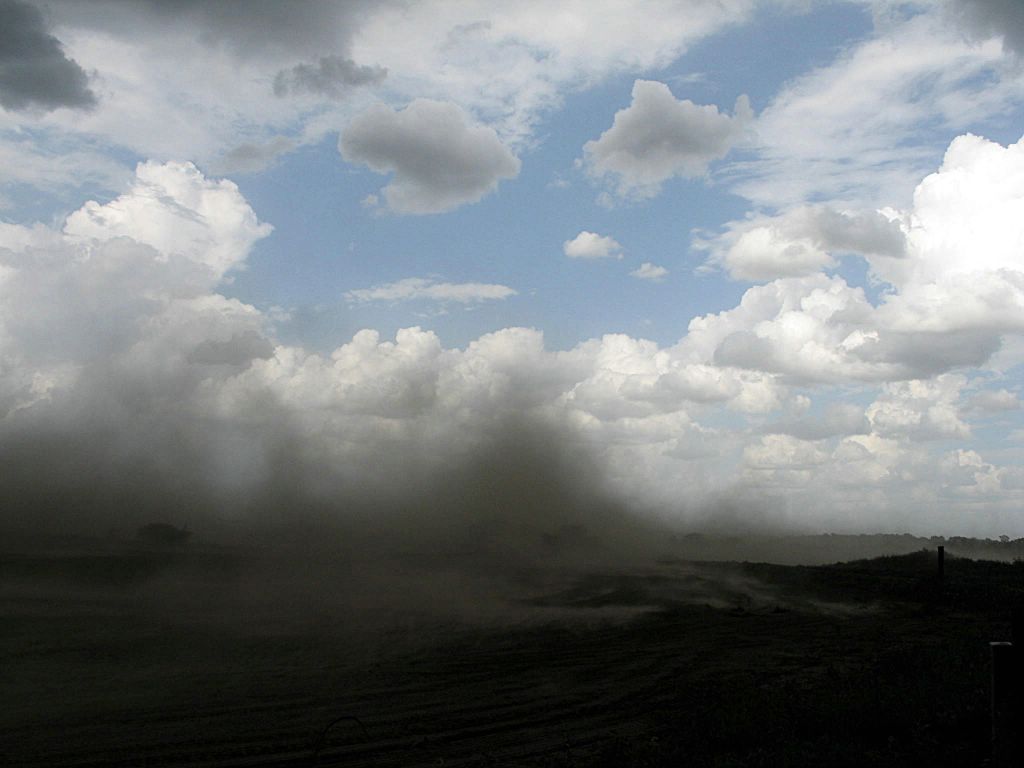
On the way to OKC to Aunt Freda's Birthday... We took the long way around to miss the storm and it kinda slipped in behind us.. this was the wind whipping across the Oklahoma plains near the Cimarron River on Highway 33. It was an awesome site. I have never in my life seen such a pretty site. The sand was dancing under the strength of the wind.. It was sooo cool that Paul stopped and I snapped a few shots. Will post the rest later.. It was just awesome.. then we took off and headed down the Turner Turnpike and ended up late due to two wrecks and miles of stop and go driving in a 75 posted, 85 usually mile per hour highway!!

Friday, August 12, 2005
Spacecraft Blasts Off to Gather Mars Data
Spacecraft Blasts Off to Gather Mars Data
By MIKE SCHNEIDER, Associated Press
(Link to some GREAT PHOTOS)
A spacecraft blasted off Friday into a golden early morning sky, beginning a mission to Mars to gather more data on the Red Planet than all combined previous missions.
The Mars Reconnaissance Orbiter lifted off on an Atlas V rocket on a seven-month journey to Mars.
"Surveying for the deepest insights into the mysterious evolution of Mars!" NASA commentator George Diller said after liftoff.
The launch went flawlessly. The booster rocket shut down and dropped off into the Atlantic minutes after liftoff, and the second-stage rocket separated less than an hour later, leading workers at the launch control center to break into applause. A short time later, two solar panels that will provide power during the voyage unfolded from the orbiter.
"It couldn't have been any smoother," said launch manager Chuck Dovale. The launch came just three days after space shuttle Discovery completed its mission.
Circling the planet for at least four years, the orbiter is to provide unparalleled information on Mars' weather, climate and geology, which could aid possible future human exploration of the Red Planet.
The $720 million mission is divided into two parts.
During its first two years, the orbiter will help build on NASA's knowledge of the history of ice on the planet. The planet is cold and dry with large caps of frozen water at its poles. But scientists think it was a wetter and possibly warmer place eons ago — conditions that might have been conducive to life. Scientists are also trying to determine if it could support future human outposts.
Equipped with the largest telescopic camera ever sent to another planet, the orbiter also will collect data that will help NASA plan where to land two robotic explorers later this decade. The Phoenix Mars Scout, in search of organic chemicals, will be launched in 2007, and the Mars Science Laboratory will follow two years later.
During the second phase of its mission, the orbiter will serve as a communications messenger between the robotic explorers on Mars and Earth. The reconnaissance orbiter has a powerful antenna that can transmit 10 times more data per minute than the current trio of satellites positioned around the planet — NASA's Global Surveyor and Mars Odyssey and the European Space Agency's Mars Express.
Two NASA rovers launched in 2003, Spirit and Opportunity, continue to roam the planet and may be the first to relay information back to Earth via the reconnaissance orbiter.
The orbiter is loaded with two cameras that will provide high-resolution images and global maps of Martian weather, a spectrometer that will identify water-related minerals and a radiometer to measure atmospheric dust. The Italian Space Agency has provided ground-penetrating radar that will peer beneath the surface of layers of rocks or ice.
___
On the Net:
http://marsprogram.jpl.nasa.gov/mro/index.html
By MIKE SCHNEIDER, Associated Press
(Link to some GREAT PHOTOS)
A spacecraft blasted off Friday into a golden early morning sky, beginning a mission to Mars to gather more data on the Red Planet than all combined previous missions.
The Mars Reconnaissance Orbiter lifted off on an Atlas V rocket on a seven-month journey to Mars.
"Surveying for the deepest insights into the mysterious evolution of Mars!" NASA commentator George Diller said after liftoff.
The launch went flawlessly. The booster rocket shut down and dropped off into the Atlantic minutes after liftoff, and the second-stage rocket separated less than an hour later, leading workers at the launch control center to break into applause. A short time later, two solar panels that will provide power during the voyage unfolded from the orbiter.
"It couldn't have been any smoother," said launch manager Chuck Dovale. The launch came just three days after space shuttle Discovery completed its mission.
Circling the planet for at least four years, the orbiter is to provide unparalleled information on Mars' weather, climate and geology, which could aid possible future human exploration of the Red Planet.
The $720 million mission is divided into two parts.
During its first two years, the orbiter will help build on NASA's knowledge of the history of ice on the planet. The planet is cold and dry with large caps of frozen water at its poles. But scientists think it was a wetter and possibly warmer place eons ago — conditions that might have been conducive to life. Scientists are also trying to determine if it could support future human outposts.
Equipped with the largest telescopic camera ever sent to another planet, the orbiter also will collect data that will help NASA plan where to land two robotic explorers later this decade. The Phoenix Mars Scout, in search of organic chemicals, will be launched in 2007, and the Mars Science Laboratory will follow two years later.
During the second phase of its mission, the orbiter will serve as a communications messenger between the robotic explorers on Mars and Earth. The reconnaissance orbiter has a powerful antenna that can transmit 10 times more data per minute than the current trio of satellites positioned around the planet — NASA's Global Surveyor and Mars Odyssey and the European Space Agency's Mars Express.
Two NASA rovers launched in 2003, Spirit and Opportunity, continue to roam the planet and may be the first to relay information back to Earth via the reconnaissance orbiter.
The orbiter is loaded with two cameras that will provide high-resolution images and global maps of Martian weather, a spectrometer that will identify water-related minerals and a radiometer to measure atmospheric dust. The Italian Space Agency has provided ground-penetrating radar that will peer beneath the surface of layers of rocks or ice.
___
On the Net:
http://marsprogram.jpl.nasa.gov/mro/index.html
Thursday, August 11, 2005
1905 - 100 years ago.. what a difference a 100 years makes.. from Uncle Ivan..
THE YEAR 1905
Maybe this will boggle your mind, I know it did mine! The year is 1905, one hundred years ago.
What a difference a century makes!
Here are some of the U.S.statistics for 1905:
The average life expectancy in the U.S. was 47 years.
Only 14 percent of the homes in the U.S.had a bathtub.
Only 8 percent of the homes had a telephone.
A three-minute call from Denverto New York City cost eleven dollars.
There were only 8,000 cars in the U.S., and only 144 miles of paved roads.
The maximum speed limit in most cities was 10 mph.
Alabama, Mississippi, Iowa, and Tennessee were each more heavily populated than California.
With a mere 1.4 million residents, California was only the 21st most populous state in the Union.
The tallest structure in the world was the EiffelTower!
The average wage in the U.S.was 22 cents an hour.
The average U.S.worker made between $200 and $400 per year.
A competent accountant could expect to earn $2000 per year, a dentist $2,500 per year, a veterinarian between $1,500 and $4,000 per year, and a mechanical engineer about $5,000 per year.
More than 95 percent of all births in the U.S.took place at home.
Ninety percent of all U.S. physicians had no college education.
Instead, they attended medical schools, many of which were condemned in the press and by the government as "substandard."
Sugar cost four cents a pound.
Eggs were fourteen cents a dozen.
Coffee was fifteen cents a pound.
Most women only washed their hair once a month, and used borax or egg yolks for shampoo.
Canadapassed a law prohibiting poor people from entering the country for any reason.
The five leading causes of death in the U.S.were:
1. Pneumonia and influenza
2. Tuberculosis
3. Diarrhea
4. Heart disease
5. Stroke
The American flag had 45 stars.
Arizona, Oklahoma, New Mexico, Hawaii, and Alaskahadn't been admitted to the Union yet.
The population of Las Vegas, Nevada, was 30!!!
Crossword puzzles, canned beer, and iced tea hadn't been invented.
There was no Mother's Day or Father's Day.
Two of 10 U.S. adults couldn't read or write.
Only 6 percent of all Americans had graduated high school.
Marijuana, heroin, and morphine were all available over the counter at corner drugstores.
According to one pharmacist, "Heroin clears the complexion, gives buoyancy to the mind, regulates the stomach and bowels, and is, in fact, a perfect guardian of health."
Eighteen percent of households in the U.S had at least one full-time servant or domestic.
There were only about 230 reported murders in the entire U.S.
Maybe this will boggle your mind, I know it did mine! The year is 1905, one hundred years ago.
What a difference a century makes!
Here are some of the U.S.statistics for 1905:
The average life expectancy in the U.S. was 47 years.
Only 14 percent of the homes in the U.S.had a bathtub.
Only 8 percent of the homes had a telephone.
A three-minute call from Denverto New York City cost eleven dollars.
There were only 8,000 cars in the U.S., and only 144 miles of paved roads.
The maximum speed limit in most cities was 10 mph.
Alabama, Mississippi, Iowa, and Tennessee were each more heavily populated than California.
With a mere 1.4 million residents, California was only the 21st most populous state in the Union.
The tallest structure in the world was the EiffelTower!
The average wage in the U.S.was 22 cents an hour.
The average U.S.worker made between $200 and $400 per year.
A competent accountant could expect to earn $2000 per year, a dentist $2,500 per year, a veterinarian between $1,500 and $4,000 per year, and a mechanical engineer about $5,000 per year.
More than 95 percent of all births in the U.S.took place at home.
Ninety percent of all U.S. physicians had no college education.
Instead, they attended medical schools, many of which were condemned in the press and by the government as "substandard."
Sugar cost four cents a pound.
Eggs were fourteen cents a dozen.
Coffee was fifteen cents a pound.
Most women only washed their hair once a month, and used borax or egg yolks for shampoo.
Canadapassed a law prohibiting poor people from entering the country for any reason.
The five leading causes of death in the U.S.were:
1. Pneumonia and influenza
2. Tuberculosis
3. Diarrhea
4. Heart disease
5. Stroke
The American flag had 45 stars.
Arizona, Oklahoma, New Mexico, Hawaii, and Alaskahadn't been admitted to the Union yet.
The population of Las Vegas, Nevada, was 30!!!
Crossword puzzles, canned beer, and iced tea hadn't been invented.
There was no Mother's Day or Father's Day.
Two of 10 U.S. adults couldn't read or write.
Only 6 percent of all Americans had graduated high school.
Marijuana, heroin, and morphine were all available over the counter at corner drugstores.
According to one pharmacist, "Heroin clears the complexion, gives buoyancy to the mind, regulates the stomach and bowels, and is, in fact, a perfect guardian of health."
Eighteen percent of households in the U.S had at least one full-time servant or domestic.
There were only about 230 reported murders in the entire U.S.
Welcome - Our Moffat Family Blog
Sound familiar???
~~~~~~~~~~~~~~~~~~~~~~`
NASA Postpones Launch of Mars Orbiter By MIKE SCHNEIDER, Associated Press Writer
CAPE CANAVERAL, Fla. - NASA postponed launching a spacecraft to Mars on Thursday after a glitch popped up in the computer software used for monitoring the fueling of the rocket used for liftoff.
The problem with sensors and software that measure the amount of fuel being loaded into the rocket appeared with just minutes left until liftoff. The launch was rescheduled for Friday morning.
The Mars Reconnaissance Orbiter was expected to spend at least four years circling Mars.
~~~~~~~~~~~~~~~~~~~~~~`
NASA Postpones Launch of Mars Orbiter By MIKE SCHNEIDER, Associated Press Writer
CAPE CANAVERAL, Fla. - NASA postponed launching a spacecraft to Mars on Thursday after a glitch popped up in the computer software used for monitoring the fueling of the rocket used for liftoff.
The problem with sensors and software that measure the amount of fuel being loaded into the rocket appeared with just minutes left until liftoff. The launch was rescheduled for Friday morning.
The Mars Reconnaissance Orbiter was expected to spend at least four years circling Mars.
Tuesday, August 09, 2005
short videos from Sunday's family gathering...
http://www.paynecountyline.com/avifamily/08072005kaitlyn.avi
http://www.paynecountyline.com/avifamily/kaitlynandrew.avi
http://www.paynecountyline.com/avifamily/kaitlynmadison.avi
http://www.paynecountyline.com/avifamily/kaitlynplaying.avi
http://www.paynecountyline.com/avifamily/madisonkaitlyn.avi
http://www.paynecountyline.com/avifamily/sidewayskaitlyn.avi
http://www.paynecountyline.com/avifamily/twokiddos.avi
http://www.paynecountyline.com/avifamily/kaitlynandrew.avi
http://www.paynecountyline.com/avifamily/kaitlynmadison.avi
http://www.paynecountyline.com/avifamily/kaitlynplaying.avi
http://www.paynecountyline.com/avifamily/madisonkaitlyn.avi
http://www.paynecountyline.com/avifamily/sidewayskaitlyn.avi
http://www.paynecountyline.com/avifamily/twokiddos.avi
another ditty from Uncle Ivan... Wear Red on Fridays. to support our military
RED FRIDAY
You will soon see a lot of people wearing Red on Fridays. Here's why.....
The Americans, who support our troops, are the silent majority. We are not
"organized" to reflect who we are, or to reflect what our opinions are. Many
Americans, like yourself, and all their friends, simply want to recognize
that Americans support our troops.
Our idea of showing our solidarity and support for our troops is starting
Friday and continuing on each and every Friday, until this is over, that
every red -blooded American who supports our young men and women, WEAR
SOMETHING RED. Word of mouth, press, TV -- let's see if we can make the
United States, on any given Friday, a sea of red much like a home football
game at a University.
If every one of our memberships share this with other acquaintances, fellow
workers, friends, and neighbors, I guarantee ! that it will not be long
before the USA will be covered in RED - and make our troops know there are
many people thinking of their well-being. You will feel better all day
Friday when you wear Red! So let's get the word out and lead by example;
wear RED on Fridays.
You will soon see a lot of people wearing Red on Fridays. Here's why.....
The Americans, who support our troops, are the silent majority. We are not
"organized" to reflect who we are, or to reflect what our opinions are. Many
Americans, like yourself, and all their friends, simply want to recognize
that Americans support our troops.
Our idea of showing our solidarity and support for our troops is starting
Friday and continuing on each and every Friday, until this is over, that
every red -blooded American who supports our young men and women, WEAR
SOMETHING RED. Word of mouth, press, TV -- let's see if we can make the
United States, on any given Friday, a sea of red much like a home football
game at a University.
If every one of our memberships share this with other acquaintances, fellow
workers, friends, and neighbors, I guarantee ! that it will not be long
before the USA will be covered in RED - and make our troops know there are
many people thinking of their well-being. You will feel better all day
Friday when you wear Red! So let's get the word out and lead by example;
wear RED on Fridays.
From Uncle Ivan... Red Skelton's advice on happy marriages.....
Tips for a Happy Marriage by Red Skelton
1. Two times a week, we go to a nice restaurant, have a little beverage,
good food and companionship. She goes on Tuesdays, I go on Fridays.
2. We also sleep in separate beds. Hers is in California and mine is in
Texas.
3. I take my wife everywhere . . but she keeps finding her way back.
4. I asked my wife where she wanted to go for our anniversary. "Somewhere I
haven't been in a long time!" she said. So I suggested the kitchen.
5. We always hold hands. If I let go, she shops.
6. She has an electric blender, electric toaster and electric bread maker.
She said "There are too many gadgets and no place to sit down!" So I bought
her an electric chair.
7. My wife told me the car wasn't running well because there was water in
the carburetor. I asked where the car was; she told me "In the lake."
8. She got a mud pack and looked great for two days. Then the mud fell off.
9. She ran after the garbage truck, yelling "Am I too late for the
garbage?" The driver yelled back, "No! Jump in!"
10. Remember: Marriage is the number one cause of divorce.
11. I married Miss Right. I just didn't know her first name was Always.
12. I haven't spoken to my wife in 18 months. I don't like to interrupt her.
13. The last fight was my fault though. My wife asked "What's on the TV?" I
said "Dust!"
1. Two times a week, we go to a nice restaurant, have a little beverage,
good food and companionship. She goes on Tuesdays, I go on Fridays.
2. We also sleep in separate beds. Hers is in California and mine is in
Texas.
3. I take my wife everywhere . . but she keeps finding her way back.
4. I asked my wife where she wanted to go for our anniversary. "Somewhere I
haven't been in a long time!" she said. So I suggested the kitchen.
5. We always hold hands. If I let go, she shops.
6. She has an electric blender, electric toaster and electric bread maker.
She said "There are too many gadgets and no place to sit down!" So I bought
her an electric chair.
7. My wife told me the car wasn't running well because there was water in
the carburetor. I asked where the car was; she told me "In the lake."
8. She got a mud pack and looked great for two days. Then the mud fell off.
9. She ran after the garbage truck, yelling "Am I too late for the
garbage?" The driver yelled back, "No! Jump in!"
10. Remember: Marriage is the number one cause of divorce.
11. I married Miss Right. I just didn't know her first name was Always.
12. I haven't spoken to my wife in 18 months. I don't like to interrupt her.
13. The last fight was my fault though. My wife asked "What's on the TV?" I
said "Dust!"

Next US Mars probe set for launch
Nasa's latest Mars mission is set to be launched on Wednesday.
The Mars Reconaissance Orbiter (MRO) will search the planet for promising landing sites for future robotic missions, in the US quest to eventually send astronauts to Mars.
The spacecraft could identify suitable habitats for life on the Red Planet.
A rocket carrying the probe is due to blast-off from Cape Canaveral at 7.54am (11.54 GMT).
Water search
The MRO is the biggest spacecraft to be sent to Mars, carrying some of the most sophisticated instruments ever.
"MRO is the next step in our ambitious exploration of Mars," said Douglas McCuistion, director of Nasa's Mars exploration programme.
MRO Cost: $500m Weight: 2,180kg Payload: Three cameras and instruments to analyse the atmosphere of Mars, monitor the Martian weather, study minerals and search for sub-surface water
"We expect to use this spacecraft's eyes in the sky in coming years as our primary tools to identify and evaluate the best places for future missions to land."
The spacecraft will arrive at Mars in March 2006. It will study the composition and structure of Mars and serve as a powerful communications relay for future missions to the surface.
One of its scientific objectives is to explore whether Mars could once have supported microbial life. Its cameras and spectrometers will scour the surface for features related to water, without which life cannot survive. Meanwhile, a radar sounder will look for liquid water reservoirs that may exist beneath the surface of Mars.
Beagle clues
British scientists hope it will also discover what happened to the lost Mars probe, Beagle 2.
Professor Colin Pillinger, from the Open University, who led the Beagle 2 mission, said: "If we could just see some trace of it on the surface then at least we could see how far it got - the not knowing is the worst bit.
"It will be a very difficult thing to do, but this is our best chance of finding out what happened and we will be watching the progress of the mission with great interest and anticipation."
The MRO will join two US orbiters - the Mars Global Surveyor and Mars Odyssey - and one European orbiter, Mars Express, at the Red Planet.
Two US robotic rovers, Spirit and Opportunity, have been on the Martian surface for the past 18 months, investigating the geology of Mars.
Nasa is planning two further Mars mission this decade: the Phoenix module, set for launch in 2007, and a Mars Science Laboratory in 2009.
Here goes some more of our American Rights out the window... hummmmm
Brit License Plates Get Chipped By Mark Baard
Story location: http://www.wired.com/news/privacy/0,1848,68429,00.html
02:00 AM Aug. 09, 2005 PT
The British government is preparing to test new high-tech license plates containing microchips capable of transmitting unique vehicle identification numbers and other data to readers more than 300 feet away.
Officials in the United States say they'll be closely watching the British trial as they contemplate initiating their own tests of the plates, which incorporate radio frequency identification, or RFID, tags to make vehicles electronically trackable.
"We definitely have an interest in testing an RFID-tagged license plate," said Jerry Dike, chairman of the American Association of Motor Vehicle Administrators and director of the Vehicle Titles and Registration Division of the Texas Department of Transportation.
So-called "active" RFID tags, like the one in the e-Plate made by the U.K. firm Hills Numberplates, have built-in batteries, allowing them to broadcast data much farther than the small passive tags used to track inventory at retail stores.
Active RFID is already enjoying limited use on U.S. roadways. Under a new program, the U.S. Department of Homeland Security is issuing RFID tags to foreign freight and passenger vehicles as they enter the country.
The technology is also used in electronic toll-collection systems in the United States to automatically charge participating drivers as they breeze past unstaffed toll booths. In the San Francisco Bay Area, FasTrak toll transponders are also polled at readers away from the toll booths, to determine how quickly traffic is moving through particular areas.
Proponents argue that making such RFID tags mandatory and ubiquitous is a logical move to counter the threat of terrorists using the roadways, and that it will scoop up insurance and registration scofflaws in the process.
"We see tremendous advantages to the (e-Plate) for everything from verifying registration and insurance to Amber (missing child) Alerts," said Dike. But because the RFID plates can cost 10 times more than ordinary plates, they will need strong support from governors and state legislatures before they are tested in the states, Dike added. "It will be several years before Texas will be able to test the e-Plate" on any of the 4 million to 4.5 million cars it registers annually.
Privacy advocates are less enthusiastic about the technology.
"It's too easy for (RFID license plates) to become a back-door surveillance tool," said Jim Harper, director of information studies at libertarian think tank the Cato Institute and a member of the U.S. Department of Homeland Security's Data Privacy and Integrity Advisory Committee.
Civil libertarians don't object to an RFID automatic toll-collection system that "anonymizes" vehicles in databases once a transaction is completed. But they doubt the government -- given its thirst for intelligence -- will use such privacy-protection measures. From a law-enforcement perspective, "there is no reason to have privacy for anything," said Lee Tien, senior staff attorney at the Electronic Frontier Foundation.
Active RFID is a huge improvement over cameras that use optical character recognition to read license plates and are accurate only 75 to 90 percent of the time, said Michael Wolf, president of the EVI Management Group.
The U.K. Department for Transport gave the official go-ahead for the microchipped number plates (as they are called in the United Kingdom) last week, and the trial is expected to begin later this year. The government has been tight-lipped about the details. One of the vendors bidding to participate in the trial said it would start with smartplates added to some police cars.
The point of the test is to see whether microchips will make number plates harder to tamper with and clone, said U.K. Department for Transport spokesman Ian Weller-Skitt.
Many commuters use counterfeit plates to avoid the London congestion charge, a fee imposed on passenger vehicles entering central London during busy hours.
Story location: http://www.wired.com/news/privacy/0,1848,68429,00.html
02:00 AM Aug. 09, 2005 PT
The British government is preparing to test new high-tech license plates containing microchips capable of transmitting unique vehicle identification numbers and other data to readers more than 300 feet away.
Officials in the United States say they'll be closely watching the British trial as they contemplate initiating their own tests of the plates, which incorporate radio frequency identification, or RFID, tags to make vehicles electronically trackable.
"We definitely have an interest in testing an RFID-tagged license plate," said Jerry Dike, chairman of the American Association of Motor Vehicle Administrators and director of the Vehicle Titles and Registration Division of the Texas Department of Transportation.
So-called "active" RFID tags, like the one in the e-Plate made by the U.K. firm Hills Numberplates, have built-in batteries, allowing them to broadcast data much farther than the small passive tags used to track inventory at retail stores.
Active RFID is already enjoying limited use on U.S. roadways. Under a new program, the U.S. Department of Homeland Security is issuing RFID tags to foreign freight and passenger vehicles as they enter the country.
The technology is also used in electronic toll-collection systems in the United States to automatically charge participating drivers as they breeze past unstaffed toll booths. In the San Francisco Bay Area, FasTrak toll transponders are also polled at readers away from the toll booths, to determine how quickly traffic is moving through particular areas.
Proponents argue that making such RFID tags mandatory and ubiquitous is a logical move to counter the threat of terrorists using the roadways, and that it will scoop up insurance and registration scofflaws in the process.
"We see tremendous advantages to the (e-Plate) for everything from verifying registration and insurance to Amber (missing child) Alerts," said Dike. But because the RFID plates can cost 10 times more than ordinary plates, they will need strong support from governors and state legislatures before they are tested in the states, Dike added. "It will be several years before Texas will be able to test the e-Plate" on any of the 4 million to 4.5 million cars it registers annually.
Privacy advocates are less enthusiastic about the technology.
"It's too easy for (RFID license plates) to become a back-door surveillance tool," said Jim Harper, director of information studies at libertarian think tank the Cato Institute and a member of the U.S. Department of Homeland Security's Data Privacy and Integrity Advisory Committee.
Civil libertarians don't object to an RFID automatic toll-collection system that "anonymizes" vehicles in databases once a transaction is completed. But they doubt the government -- given its thirst for intelligence -- will use such privacy-protection measures. From a law-enforcement perspective, "there is no reason to have privacy for anything," said Lee Tien, senior staff attorney at the Electronic Frontier Foundation.
Active RFID is a huge improvement over cameras that use optical character recognition to read license plates and are accurate only 75 to 90 percent of the time, said Michael Wolf, president of the EVI Management Group.
The U.K. Department for Transport gave the official go-ahead for the microchipped number plates (as they are called in the United Kingdom) last week, and the trial is expected to begin later this year. The government has been tight-lipped about the details. One of the vendors bidding to participate in the trial said it would start with smartplates added to some police cars.
The point of the test is to see whether microchips will make number plates harder to tamper with and clone, said U.K. Department for Transport spokesman Ian Weller-Skitt.
Many commuters use counterfeit plates to avoid the London congestion charge, a fee imposed on passenger vehicles entering central London during busy hours.
Subscribe to:
Posts (Atom)