Wednesday, April 18, 2007


Be The Change:
Be The Change:
Experiment with looking at the child within each person you interact with. How does this change the way you relate to them?
Experiment with looking at the child within each person you interact with. How does this change the way you relate to them?
You can understand and relate to most people better if
You can understand and relate to most people better if you look at them -- no matter how old or impressive they may be -- as if they are children. For most of us never really grow up or mature all that much -- we simply grow taller. O, to be sure, we laugh less and play less and wear uncomfortable disguises like adults, but beneath the costume is the child we always are, whose needs are simple, whose daily life is still best described by fairy tales. --Leo Rosten
Monday, April 16, 2007
A view from inside my world on Saturday, April 14, 2007...

I am sure this is not a big deal to some but as I got to thinking about it, it becomes bigger and bigger... haha....
When Ann and I bought our first computer it was a Tandy SX 1000 and it had 2 mgs of storage.... yes MGS. We also bought a subscription to PCLINK, the first online service available in Stillwater and when we got home, we could only dial up and hook up at 600 bps... and could only call the Stillwater Airport and get time and temp. nothing else.. then we discovered we had bought the first system available from Tandy in Stillwater, and then we discovered we were the first ones 'online' from Stillwater, OK. and on and on..
Well, Saturday was another first... We helped bring Pickens Auctions to the world.
What you see are my tools inside my office on Saturday. I used my Blackjack as a modem and hooked up my laptop and a Creative Live Pro webcam with audio and signed on to NAAlive. com and we had an auction open to the world. We had bidders from Mexico, Netherlands, and all over the USA. Now to a lot of you this is nothing, but it was quite an honor for me to be involved in this and now an even bigger honor of being the first in Oklahoma to offer this service and the first in Stillwater to do such. What a ride this has been. Al Gore may have invented the internet, but we have used it for as long as it has been open to the public!
it is still hard for me to believe we did the auction on Saturday. I had a total of about 3 pounds of equipment, three pieces and one cord and ran all off of the cigarette lighter in my truck! wow...
Wonder what will be next. It is such an honor to be working with Gregg Pickens, a long time family friend who loves to stay up to date with things...
Anywho.. just sharing an exciting time in my life.. haha... there are pics from the auction online at pickensauctions.com and then to the photo gallery two...
Enjoy the day....
Stan

Sunday, April 15, 2007
COWARDS KICK AWAY ANOTHER PIECE OF AMERICA'S SOUL
By KINKY FRIEDMAN
April 15, 2007 -- Author, musician and former Texas gubernatorial candidate Kinky Friedman has been friends with Don Imus since 1975, when they met on stage at The Bottom Line.
I MET Imus on the gangplank of Noah's Ark. He was then and remains today a truth-seeking missile with the best bull-meter in the business.
Far from being a bully, he was a spiritual chop-buster never afraid to go after the big guys with nothing but the slingshot of ragged integrity. I watched him over the years as he struggled with his demons and conquered them. This was not surprising to me.
Imus came from the Great Southwest, where the men are men and the emus are nervous. And he did it all with something that seems, indeed, to be a rather scarce commodity these days. A sense of humor.
There's no excusing Imus' recent ridiculous remark, but there's something not kosher in America when one guy gets a Grammy and one gets fired for the same line.
The Matt Lauers and Al Rokers of this world live by the cue-card and die by the cue-card; Imus is a rare bird, indeed - he works without a net. When you work without a net as long as Imus has, sometimes you make mistakes.
Wavy Gravy says he salutes mistakes. They're what makes us human, he claims. And humanity beyond doubt, is what appears to be missing from this equation. If we've lost the ability to laugh at ourselves, to laugh at each other, to laugh together, then the PC world has succeeded in diminishing us all.
Political correctness, a term first used by Joseph Stalin, has trivialized, sanitized and homogenized America, transforming us into a nation of chain establishments and chain people.
Take heart, Imus. You're merely joining a long and legendary laundry list of individuals who were summarily sacrificed in the name of society's sanctimonious soul: Socrates, Jesus, Galileo, Joan of Arc, Mozart and Mark Twain, who was decried as a racist until the day he died for using the N-word rather prolifically in "Huckleberry Finn."
Speaking of which, there will always be plenty of Al Sharptons and Jesse Jacksons around. There will be plenty of cowardly executives, plenty of fair-weather friends, and plenty of Jehovah's Bystanders, people who believe in God but just don't want to get involved. In this crowd, it could be argued that we need a Don Imus just to wake us up once in a while.
There probably isn't a single one of Imus' vocal critics who come anywhere close to matching his record of philanthropy or good acts on this earth.
Judge a man by the size of his enemies, my father used to say. A man who, year after year, has raised countless millions of dollars and has fought hand-to-hand to combat against childhood cancer, autism, and SIDS - well, you've got a rodeo clown who not only rescues the cowboy, but saves the children as well.
I believe New York will miss its crazy cowboy and America will miss the voice of a free-thinking independent-minded, rugged individualist. I believe MSNBC will lose many viewers and CBS radio many listeners.
Too bad for them. That's what happens when you get rid of the only guy you've got who knows how to ride, shoot straight and tell the truth.
April 15, 2007 -- Author, musician and former Texas gubernatorial candidate Kinky Friedman has been friends with Don Imus since 1975, when they met on stage at The Bottom Line.
I MET Imus on the gangplank of Noah's Ark. He was then and remains today a truth-seeking missile with the best bull-meter in the business.
Far from being a bully, he was a spiritual chop-buster never afraid to go after the big guys with nothing but the slingshot of ragged integrity. I watched him over the years as he struggled with his demons and conquered them. This was not surprising to me.
Imus came from the Great Southwest, where the men are men and the emus are nervous. And he did it all with something that seems, indeed, to be a rather scarce commodity these days. A sense of humor.
There's no excusing Imus' recent ridiculous remark, but there's something not kosher in America when one guy gets a Grammy and one gets fired for the same line.
The Matt Lauers and Al Rokers of this world live by the cue-card and die by the cue-card; Imus is a rare bird, indeed - he works without a net. When you work without a net as long as Imus has, sometimes you make mistakes.
Wavy Gravy says he salutes mistakes. They're what makes us human, he claims. And humanity beyond doubt, is what appears to be missing from this equation. If we've lost the ability to laugh at ourselves, to laugh at each other, to laugh together, then the PC world has succeeded in diminishing us all.
Political correctness, a term first used by Joseph Stalin, has trivialized, sanitized and homogenized America, transforming us into a nation of chain establishments and chain people.
Take heart, Imus. You're merely joining a long and legendary laundry list of individuals who were summarily sacrificed in the name of society's sanctimonious soul: Socrates, Jesus, Galileo, Joan of Arc, Mozart and Mark Twain, who was decried as a racist until the day he died for using the N-word rather prolifically in "Huckleberry Finn."
Speaking of which, there will always be plenty of Al Sharptons and Jesse Jacksons around. There will be plenty of cowardly executives, plenty of fair-weather friends, and plenty of Jehovah's Bystanders, people who believe in God but just don't want to get involved. In this crowd, it could be argued that we need a Don Imus just to wake us up once in a while.
There probably isn't a single one of Imus' vocal critics who come anywhere close to matching his record of philanthropy or good acts on this earth.
Judge a man by the size of his enemies, my father used to say. A man who, year after year, has raised countless millions of dollars and has fought hand-to-hand to combat against childhood cancer, autism, and SIDS - well, you've got a rodeo clown who not only rescues the cowboy, but saves the children as well.
I believe New York will miss its crazy cowboy and America will miss the voice of a free-thinking independent-minded, rugged individualist. I believe MSNBC will lose many viewers and CBS radio many listeners.
Too bad for them. That's what happens when you get rid of the only guy you've got who knows how to ride, shoot straight and tell the truth.
Wednesday, April 11, 2007
Andrew is getting ready to throw out the first ball of summer....
Good Morning all..
Andrew's first tball game is Friday the 20th at 6pm. They will play at Strickland which is behind Mexico Joes. We will be getting complete schedule that day with the rest of his games.
Heather
Andrew's first tball game is Friday the 20th at 6pm. They will play at Strickland which is behind Mexico Joes. We will be getting complete schedule that day with the rest of his games.
Heather
Tuesday, April 10, 2007
I found this interesting... trust in the workplace, or relationship...
Why do you claim that "Trust" is the key leadership competency of the new global economy?
Covey: If you look at the nature of the world today, a foundational condition in Thomas Friedman's flat world is the presence of trust. Put simply, today's increasingly global marketplace puts a premium on true collaboration, teaming, relationships and partnering, and all these interdependencies require trust. In the book I point out that partnerships based on trust outperform partnerships based on contracts. Compliance does not foster innovation, trust does. You can't sustain long-term innovation, for example, in a climate of distrust.
In issue after issue, the data is clear: high trust organizations outperform low-trust organizations. Total return to shareholders in high trust organizations is almost three times higher than the return in low trust organizations.
So we assert that trust is clearly a key competency. A competency or skill that can be learned, taught, and improved and one that talent can be screened for.
Trust is the one thing that affects everything else you're doing. It's a performance multiplier which takes your trajectory upwards, for every activity you engage in, from strategy to execution.
How do you identify a high-trust or low-trust organizations?
Covey: Trust is a powerful accelerator to performance and when trust goes up, speed also goes up while cost comes down -- producing what we call a trust dividend. How do you know if you have a high trust culture? By observing the behavior of your people. In high trust, high performance companies, we observe the following behaviors:
• Information is shared openly
• Mistakes are tolerated and encouraged as a way of learning
• The culture is innovative and creative
• People are loyal to those who are absent
• People talk straight and confront real issues
• There is real communication and real collaboration
• People share credit abundantly and openly celebrate each others' success
• There are few “meetings after the meetings”
• Transparency is a practiced value
• People are candid and authentic
• There is a high degree of accountability
• There is palpable vitality and energy—people can feel the positive momentum
Another very visible indicator is the behavior of your customers and suppliers. What is your customer churn rate? Do you have a history of long-term customer and supplier relationships? What is your reputation or brand equity in your marketplace?
Conversely, when the trust is low, there's a trust tax which changes your trajectory downwards. In our work with organizations, we find that low-trust, low-performance organizations typically exhibit cultural behaviors like:
• Facts are manipulated or distorted
• Information and knowledge are withheld and hoarded
• People spin the truth to their advantage
• Getting the credit is very important
• New ideas are openly resisted and stifled
• Mistakes are covered up or covered over
• Most people are involved in a blame game, badmouthing others
• There is an abundance of “water cooler” talk
• There are numerous “meetings after the meetings”
• There are many “undiscussables”
• People tend to over-promise and under-deliver
• There are a lot of violated expectations for which people make many excuses
• People pretend bad things aren’t happening or are in denial
• The energy level is low
• People often feel unproductive tension—sometimes even fear
These behaviors are all taxes on performance.
The work we do is to establish trust as your organizational operating system. That's a high-tech metaphor, but it's appropriate. We know how trust works, how to measure it, how to establish it, grow it, extend it, and sustain it – with all stakeholders.
Why is trust such a hidden variable to many otherwise competent managers?
Covey: Unfortunately, too many executives believe the myths about trust. Myths like how trust is soft and is merely a social virtue. The reality is that trust is hard-edged and is an economic driver.
For instance, strategy is important, but trust is the hidden variable. On paper you can have clarity around your objectives, but in a low-trust environment, your strategy won't be executed. We find the trust tax shows up in a variety of ways including fraud, bureaucracy, politics, turnover, and disengagement, where people quit mentally, but stay physically. The trust tax is real.
There are many myths about trust, and in my book I present them in a table your readers may find helpful:
| MYTH | REALITY |
| Trust is soft | Trust is hard, real, and quantifiable. It measurably affects both speed and cost |
| Trust is slow | Nothing is as fast as the speed of trust |
| Trust is built solely on integrity | Trust is a function of both character (which includes integrity) and competence |
| You either have trust or you don't | Trust can be both created and destroyed |
| Once lost, trust cannot be restored | Though difficult, in most cases, lost trust can be restored |
| You can't teach trust | Trust can be effectively taught and learned, and it can become a leverageable, strategic advantage |
| Trusting people is too risky | Not trusting people is a greater risk |
| You establish trust one person at a time | Establishing trust with the one establishes trust with the many |
So trust is measurable? quantifiable?
Covey: Absolutely, trust is measurable. Smart organizations measure trust in three key ways: 1) actual trust "levels"; 2) the "components" or dimensions that comprise trust; and 3) the "effects", or impact, of trust.
We have found that one very simple way to measure trust levels is to ask one direct question and roll it up and down throughout the organization. For internal stakeholders ask: "Do you trust your boss?" to employees at all levels of an organization. For external stakeholders, like customers or suppliers, you might ask them: "Do you trust our sales representative or account manager?" These are simple, direct questions that tell us more about our culture than perhaps any other question we might ask.
Now, wouldn't it be great if "trust" showed up on the financial statements as either a 'tax' or a 'dividend'? Organizations would then use resources to eliminate the tax or create a larger dividend! Although a high trust or low trust culture doesn't literally show up on financial statements, it does show up in the following ways, which are measurable, observable and economically relevant (all of which make a strong "business case for trust"):
| The 7 Low-Trust Organizational Taxes | The 7 High-Trust Organizational Dividends |
| 1. Redundancy | 1. Increased value |
| 2. Bureaucracy | 2. Accelerated growth |
| 3. Politics | 3. Enhanced innovation |
| 4. Disengagement | 4. Improved collaboration |
| 5. Turnover | 5. Stronger partnering |
| 6. Churn | 6. Better execution |
| 7. Fraud | 7. Heightened loyalty |
| (The opposites of the 7 Organizational Taxes are also Dividends) |
What are the competencies, the behaviors that build trust?
Covey: Trust too often has been pigeonholed as based on character and integrity alone. There's nothing wrong with that, and that is clearly the foundation, but it's insufficient.
Trust is a function of both character and competence. Of course you can't trust someone who lacks integrity, but hear this: if someone is honest but they can't perform, you're not going to trust them either. You won't trust them to get the job done.
That's one reason why trust has a soft image- because it has been severed from competence and results.
So how does one apply trust to branding?
Covey: When I look at a brand, a brand is nothing more or less than trust with the customer, trust with the marketplace. The principle behind a brand is reputation. The brand stands for a promise and the ability to deliver on that promise. And in that promise is a company's character and competence, its reputation.
From the character side you start with integrity—honesty, congruence, humility and courage. The courage to be open, to stand for something, to make and keep commitments. Then there's intent—is there a genuine concern for people, purposes and society as a whole or is profit your sole motive? What's the company's agenda? And how does it behave? Sometimes poor behavior is simply bad execution of good intent.
On the competence side, you start with your capabilities—talents, skills, the ability to deliver. Is your company staying relevant, are you continually improving, do you have the right technologies to stay ahead of your competition? Brands need to reinvent themselves from time to time to stay relevant. Finally, look at your results. Your company and your brands are constantly measured based on past performance, present performance and anticipated future performance.
These four dimensions—integrity, intent, capabilities and results—make up the credibility and reputation of your brand. When the trust is high, you get the trust dividend. Investors invest in brands people trust. Consumers buy more from companies they trust, they spend more with companies they trust, they recommend companies they trust, and they give companies they trust the benefit of the doubt when things go wrong. The list goes on and on. On the Internet, a trusted brand versus an untrusted brand—the differences could not be clearer, you only give your credit card number to those you trust. And look what happens when a brand gets diluted or polluted or compromised, we see how fast consumers, and investors, turn away. They quit buying.
These same principles apply equally to companies and individuals.
What about the social responsibility of business? Is this part of the trust equation?
Covey: Initially many companies may move into this arena for PR purposes. More out of fear of not being in the arena, than really participating with their souls. But there are huge benefits that flow from this - the difference it makes with your employees first, then your customers, your suppliers, your distributors, your investors.
The distrust we see all around is suspicion, a response to the corporate scandals and vicious downward cycles of cynicism. But when a company focuses on the principle of contribution for all stakeholders, that becomes good business. Executives need to understand the economic benefits of this trust dividend, especially when the behavior is real, not artificially or superficially created as PR to manipulate trust. We will see more and more companies moving in this direction because it makes economic sense, period.
Trust varies by geography, as you've pointed out in your book. How do companies build trust globally?
Covey: There's no question that trust issues are global issues. There's also a country tax. The Edelman Trust Barometer tells us, for example, that trust is often based on country of origin. US companies are being taxed in Europe, in Germany, France and England, for example. How can companies like UPS improve their trust rankings?

1. Talk Straight
2. Demonstrate Respect
3. Create Transparency
4. Right Wrongs
5. Show Loyalty
6. Deliver Results
7. Get Better
8. Confront Reality
9. Clarify Expectations
10. Practice Accountability
11. Listen First
12. Keep Commitments
13. Extend Trust
Companies need to have a strong promise, because the promise builds hope. Keeping the promise is what builds trust.
My father has an expression: "You can't talk yourself out of a problem you behaved yourself into." So it is with trust.
Sometimes it takes a little time, but you can accelerate the process by declaring your intent and signaling your behavior, so others can see it.
People and companies can learn these behaviors. It's not a simple process which happens overnight. But it is a systemic, cultural process which can happen one leader at a time, one division at a time, one company at a time, and you can see the behavior shifting toward authentic, real trust-building behaviors as opposed to the more common counterfeit behavior of spin and hidden agendas and the like which tend to dissipate and diminish trust.

Covey: One thing about trust is that everyone's for it.
However, there are three big objections which come up. The first one is that trust is a social virtue, to which I say no, it's much more than that; it's a hard-edged economic driver. Secondly, and we hear this all the time: "we can't do anything about trust, it's either there or it's not there." This too is a fallacy. Trust is a competency. It's something you can get good at. It's a strength you personally, and your team and your company can master. Being good at it will elevate every other strength you have.
The third complaint goes along these lines: "We've been burned before. We can't trust everyone. Are you suggesting we trust everybody?" That's where I suggest you exercise what I call "SmartTrust." Most leaders have been burned before, so they become distrusting. Our society is that way. After Enron and WorldCom, we pass legislation like Sarbanes-Oxley to force compliance, raising the "tax" on all businesses. The question is, "is there a third alternative?" An alternative where you combine a high propensity to trust with good analysis and judgment, so we can really assess the circumstances, the risk, the credibility of the people involved, so we can extend trust, and build into that trust a stewardship or responsibility.
If you're not trusted, you tend to reciprocate with distrust. That's how the vicious cycle of mistrust starts and spirals downward.
There is a risk in trusting people, but the greater risk is not trusting people.
SmartTrust says you look at the opportunity, the risk and the credibility of the people involved. And you add to that verification and analysis. So you trust and verify. As opposed to verify, then trust!
Let's look at Berkshire Hathaway and Warren Buffet. I mention them in the book as an example of a high-trust company, about the acquisition they made based on a hand shake without due diligence.
But did you know that's how the entire company operates?
They have a 192,000 employees with 42 different wholly-owned companies. How many people do you think work at corporate headquarters? '
Seventeen!
Why? Because they choose to operate in a "seamless web of deserved trust" as Charlie Munger calls it.
This is real. It's not blind trust, but smart trust.
Thank you so much. I truly believe The SPEED of Trust: The One Thing that Changes Everything
Monday, April 09, 2007
We had two takers for hunting eggs yesterday...

We had a very wonderful Easter, and hope you did too!
Heather and Ms. Madison and Mr. Andrew came over (Paul was at work and could not get away) and Jake and Trisha came too for the ole traditionally GREAT meal fixed by Grandma Ann! What a wonderful meal we had... and visit with them. Then it was time to get after the EGGS... and Andrew and Madison were truly ready to go. Of course they had on their nice Easter clothes to hunt in... but that did not stop them, haha...
Jon and Randi with Dylan and Kaitlyn spent the day with Randi's family, and then Jon hurried home to study ... and Phil, Tammy and Austyn went to my Cousin Doris and Jim Rowland's at Lexington for Easter.
Jon called last night and we visited for a bit, and he was taking a break from being knee deep in his studies... and reported they had a good visit and time and would be posting photos online this week from the days activities.
Ann and I are richly blessed. We are smart enough to know at 60 there are not a lot of holidays left and truly enjoy the ones we have with our family, as they can, and will continue to do this until...
Enjoy the day... smiling... what a nice day it is...
Sunday, April 08, 2007

Faith
[Faith is] an act, an intention, a project, something that makes you, in leaping into the future, go so far, far, far ahead that you shoot clean out of time and right into Eternity, which is not the end of time or a whole lot of time or unending time, but timelessness, the old Eternal Now. --Joanna Russ
Are humans hard-wired for faith?
Are humans hard-wired for faith?
Story Highlights
• Scientist working to track how the human brain processes religion, spirituality• New field called neurotheology
• Similar areas of the brain are affected during prayer and meditation
By A. Chris Gajilan
CNN
CNN
NEW YORK (CNN) -- "I just know God is with me. I can feel Him always," a young Haitian woman once told me.
"I've meditated and gone to another place I can't describe. Hours felt like mere minutes. It was an indescribable feeling of peace," recalled a CNN colleague.
"I've spoken in languages I've never learned. It was God speaking through me," confided a relative.
The accounts of intense religious and spiritual experiences are topics of fascination for people around the world. It's a mere glimpse into someone's faith and belief system. It's a hint at a person's intense connection with God, an omniscient being or higher plane. Most people would agree the experience of faith is immeasurable.
Dr. Andrew Newberg, neuroscientist and author of "Why We Believe What We Believe," wants to change all that. He's working on ways to track how the human brain processes religion and spirituality. It's all part of new field called neurotheology.
After spending his early medical career studying how the brain works in neurological and psychiatric conditions such as Alzheimer's and Parkinson's disease, depression and anxiety, Newberg took that brain-scanning technology and turned it toward the spiritual: Franciscan nuns, Tibetan Buddhists, and Pentecostal Christians speaking in tongues. His team members at the University of Pennsylvania were surprised by what they found.
"When we think of religious and spiritual beliefs and practices, we see a tremendous similarity across practices and across traditions."
The frontal lobe, the area right behind our foreheads, helps us focus our attention in prayer and meditation.
The parietal lobe, located near the backs of our skulls, is the seat of our sensory information. Newberg says it's involved in that feeling of becoming part of something greater than oneself.
The limbic system, nestled deep in the center, regulates our emotions and is responsible for feelings of awe and joy.
Newberg calls religion the great equalizer and points out that similar areas of the brain are affected during prayer and meditation. Newberg suggests that these brain scans may provide proof that our brains are built to believe in God. He says there may be universal features of the human mind that actually make it easier for us to believe in a higher power.
Interestingly enough, devout believers and atheists alike point to the brain scans as proof of their own ideas.
Some nuns and other believers champion the brain scans as proof of an innate, physical conduit between human beings and God. According to them, it would only make sense that God would give humans a way to communicate with the Almighty through their brain functions.
Some atheists saw these brain scans as proof that the emotions attached to religion and God are nothing more than manifestations of brain circuitry.
Scott Atran doesn't consider himself an atheist, but he says the brain scans offer little in terms of understanding why humans believe in God. He is an anthropologist and author of "In Gods We Trust: The Evolutionary Landscape of Religion."
Instead of viewing religion and spirituality as an innate quality hardwired by God in the human brain, he sees religion as a mere byproduct of evolution and Darwinian adaptation.
"Just like we're not hardwired for boats, but humans in all cultures make boats in pretty much the same way, Atran explains. "Now, that's a result both of the way the brain works and of the needs of the world, and of trying to traverse a liquid medium and so I think religion is very much like that."
Atran points to the palms of his hands as another example of evolutionary coincidence. He says the creases formed there are a mere byproduct of human beings working with our hands -- stretching back to the ages of striking the first fires, hunting the first prey to building early shelter. Although, the patterns in our palms were coincidentally formed by eons of evolution and survival, he points out that cultures around the world try to find meaning in them through different forms of palm reading.
Anthropologists like Atran say, "Religion is a byproduct of many different evolutionary functions that organized our brains for day-to-day activity."
To be sure, religion has the unparalleled power to bring people into groups. Religion has helped humans survive, adapt and evolve in groups over the ages. It's also helped us learn to cope with death, identify danger and finding mating partners.
Today, scientific images can track our thoughts on God, but it would take a long leap of faith to identify why we think of God in the first place.
A. Chris Gajilan is a senior producer with CNN Medical News.
Saturday, April 07, 2007
Great Grandma Moffat, Grandma Moffat, and Ms. Madison... in ER at Stillwater, waiting... waiting....

just another look at things..
Well, here we are in the ER with great grandma...
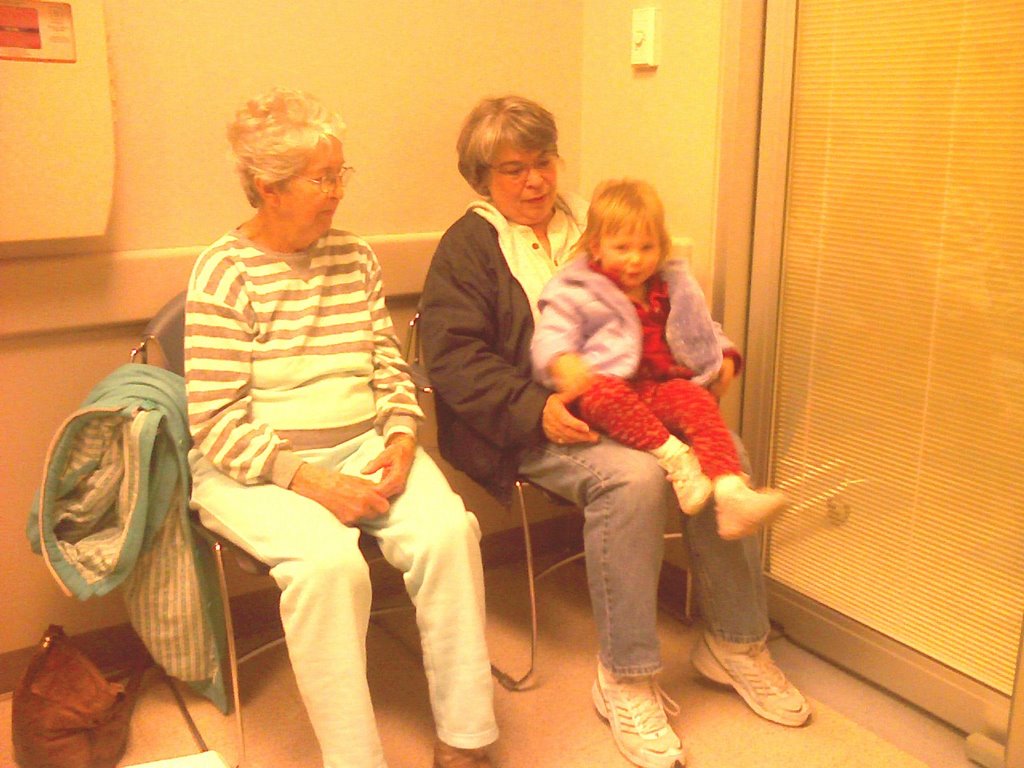
Ann and I were doing our usual things on Saturday Morning when the phone rang and it was the lady who does Mom's hair calling to ask me to come get her... she had fallen in her shop and she felt that Mom did not need to drive, so off we went. We were keeping Ms. Madison while Heather did some other Easter things ... and needless to say, it was quite a day.. haha.. We took Great Grandma by the ER in Stillwater ... where they did some some pics of things and decided that she was ok and would only be sore for a few days... and then we ate at cici's and headed home ... getting back home about 4ish... whew... and through all that, Ms. Madison was a trooper!! So I took a couple of photos to share and for her to have some day to look and and remember... haha... love to all..
a man's merit...
We should not judge of a man's merit by his great abilities, but by the use he makes of them. --Francois de la Rochefoucauld
Maryland Boy Scout earned every merit badge available

MICHAEL WILLIAMSON / AP
James Calderwood, a Boy Scout in Chevy Chase, Md., has earned 122 merit badges — so many that he had to sew three sashes together to display them all.
Maryland Boy Scout earned every merit badge available
By Paul Duggan
The Washington Post
It's not easy making Eagle, the highest honor in Boy Scouts. You need at least 21 merit badges, some required. Only 2 percent of Scouts get that far. A remarkable achievement. So what adjective should be used for James Calderwood, who has earned 121 merit badges? (Scout's honor.)
The Chevy Chase, Md., teen has every badge available, from American business to woodwork. He even has one they don't give out anymore — "atomic energy" — so make it 122.
He has so many that he can't wear them the usual way. "I actually had to make my own sash, where I took three sashes and sewed them together," he said.
The Boy Scouts of America doesn't keep records of Scouts who have earned every badge. But not many have done it, said Deborah Dean, program director for the Scouts' National Capital Area Council. Dean confirmed Calderwood's achievement, calling it "extremely rare."
Calderwood reached the 21-badge mark for Eagle in 2002 and left it in the dust.
"Bugling was probably one of the most difficult," said Calderwood, a high-school senior. "I've never been very musically gifted. And I was on five different continents over the summer, so I didn't have much time to practice. ... I brought my mouthpiece with me. I brought it to the top of Mount Kilimanjaro and everyplace else I was, and I tried to practice."
Among the other places he was over the summer (besides the top of a mountain in Tanzania): in Japan, with exchange students; in Costa Rica, working with an ecological program; and in northern Kenya, helping open a medical clinic.
"Then when I got back to the United States," he said, "I met with a music teacher two to three times a week and just kept practicing and practicing."
And finally, in January, he passed his bugle test, two days before his 18th birthday, which is the age cutoff for getting merit badges — and that was it, the final badge, No. 122.
Calderwood, who will soon graduate from Georgetown Preparatory School, is the only child of Jim Calderwood, an antitrust lawyer, and Joyce Johnson, a retired Coast Guard admiral who is vice president of a health-care concern. He joined the Boy Scouts in sixth grade. Most of his free time since has been devoted to one thing.
"I never planned on getting them all," he said. "First, I just sort of concentrated on the ones that went with my hobbies. And then I just thought I should keep going."
Here's how he did it.
• Astronomy: "I studied astrophysics at Johns Hopkins University one summer."
• Cinematography: "I filmed a video on the proper use of knives that was shown to cooks in the military. Like if you want to cut a thick fruit as the garnish, I demonstrated the proper way to cut it."
• Indian lore: "I spent a lot of time with the Native Americans. I stayed with the Hopis and the Navajos in Arizona."
• Plumbing: "Man, I've fixed more toilets in this house."
In addition to Scouting, Calderwood participates in theater, debating and other activities.
His next step is college.
"I want to be a doctor," he said. "I want to go into medicine in the developing world."
He applied to 13 colleges, and acceptance letters have poured in from universities: from Drexel and Villanova, from Creighton and Fordham, from the universities of Pennsylvania and Maryland. He isn't sure where he'll go.
But he has to make up his mind this month, and, finally, with no more badges to earn, he has time to think about it.
What was his least favorite badge? "Insect study was something I wasn't as fascinated by as much as the other ones," he said. "But there wasn't a badge that I dreaded getting. I mean, every single badge intrigued me."
Could this really happen??? Would be too good to be true... haha...

especially for those who kill Americans in the name of the Muslim faith...
Thursday, April 05, 2007
Easter is a coming....

Photo from last Easter, Andrew and Kaitlyn getting ready to 'hunt' ... my how they have grown and Kaitlyn even acquired a brother Dylan too... but I don't think he will be able to hunt, but I bet he will want too... haha...
Easter is one of my favorite holidays of the year. Besides the great importance of the day, it's also neat to see the grandkids hunting the ole Easter eggs, the joy in their innocent faces when they find an egg.. the excitement of the race, the hurry of life... and Jon throwing eggs against the dumpster.. haha....
And if you know me... I love to eat, haha... and of course it does not show... haha... and I know that Grandma Ann and the ladies will have some great food too.... so now the secret is out... haha...
Well, all I know for now, the season tis getting busy. I have several appointments with artists regarding representation by our firm, several new website accounts, lots of updates on the old ones, a new 'live auction' on farm equipment at Pauls Valley on the 14th which will be broadcast live on naalive.com, and another catalog, registered longhorns, for Perkins Livestock, and Jake gettin' hitched... and on and on...
Austyn is doing very good with his guitar lessons and has written a song or two, and his teacher has written a tune and Austyn reports it sounds great together... Andrew is excited about playing ball this summer and so is Austyn. Madison just goes goes goes..and eats eats eats.. and we hear Ms. Kaitlyn has developed an 'attitude'... haha.... and Dylan is growing and blowing. I bet he will be old enough to have a car before long, as fast as time is flying...
I wanted some garden too and Grandma Ann and I put out a bunch of flowers and things last Saturday, including some cherry tomatoes... but now the freeze might claim them... my goodness the kiddos will have to hunt the eggs fast due to how cold it will be Sunday... haha..
Enjoy the day... love to all...

Tuesday, April 03, 2007
Billy Joe Shaver (could this be another country song in the making??)

Family Badge
Billy Joe Shaver connected with Texas bar shooting
Sunday, 04/01/07
By BEVERLY KEEL, Staff Writer
Country singer-songwriter Billy Joe Shaver has been connected to a shooting in a Texas bar Saturday night.
A man was shot in the face about 8:30 p.m. on the covered back porch of Papa Joe's Texas Saloon in Lorena, a suburb of Waco, said John Moran, Lorena city manager and chief of police. The name and age of the victim, who remains in Hillcrest Baptist Medical Center, have not been released, he said.
Shaver "has not been charged with anything and hopefully he won't be charged with anything," said Austin attorney Joseph Turner, who represents the songwriter.
Turner is a well-known and highly successful criminal defense attorney who has represented Willie Nelson, Matthew McConaughey and Branch Davidian Ruth Riddle.
"He is not under arrest and they haven't issued any warrants for his arrest."
Shaver is a beloved Texas performer whose songs have been recorded by Willie Nelson, Johnny Cash, Bob Dylan, Waylon Jennings, Kris Kristofferson, Elvis Presley, Jerry Lee Lewis and Marty Stuart. His songs were the basis for Jennings' landmark 1973 Honky Tonk Heroes album.
His own hits include "Georgia on a Fast Train" in 1973 and "You Asked Me To" in 1978. He was a 2006 inductee into the Texas Music Hall of Fame.
Turner was retained by Shaver, 67, on Saturday and has been in touch with police investigators. "We are cooperating the best we can. They are still conducting the investigation.
Turner would not comment on speculation that the man who was shot had a knife.
Moran, the Lorena police chief, would not discuss details of the case or confirm that Shaver was involved.
"I am not saying this person is a person of interest at this point because it is a case in progress. The Texas Rangers are assisting in this investigation. I can't go into details on it right now."
There were witnesses to the shooting, Moran said. The Waco Tribune-Herald reported that about 25 people were in the bar.
"We've been talking to folks," Moran said. "There are a lot of people to talk to."
When asked about the shooting Sunday night, the person answering the phone at Papa Joe's said, "There wasn't none, thank you," and hung up.
However, an eyewitness told the Waco newspaper the shooting occurred outside the back door.
"All I heard was a pop," said the man, who wouldn't give the newspaper his name. "I thought it was a firecracker. (The victim) came walking back in with his hand on his cheek and had blood all over his face.
"Then I guess the (shooter) ran and got in his car and took off."
A Lorena police officer told the Waco paper that he had difficulty getting information from customers at the scene. "No one knows a thing," he told the paper. "If they do know, they’re not saying anything."
Shaver's greatest hits album is scheduled for release on Tuesday, and promotional events have not been canceled. Shaver is set to deliver an in-store performance at Waterloo in Austin on Tuesday, said his manager, Brad Turcotte.
Subscribe to:
Posts (Atom)