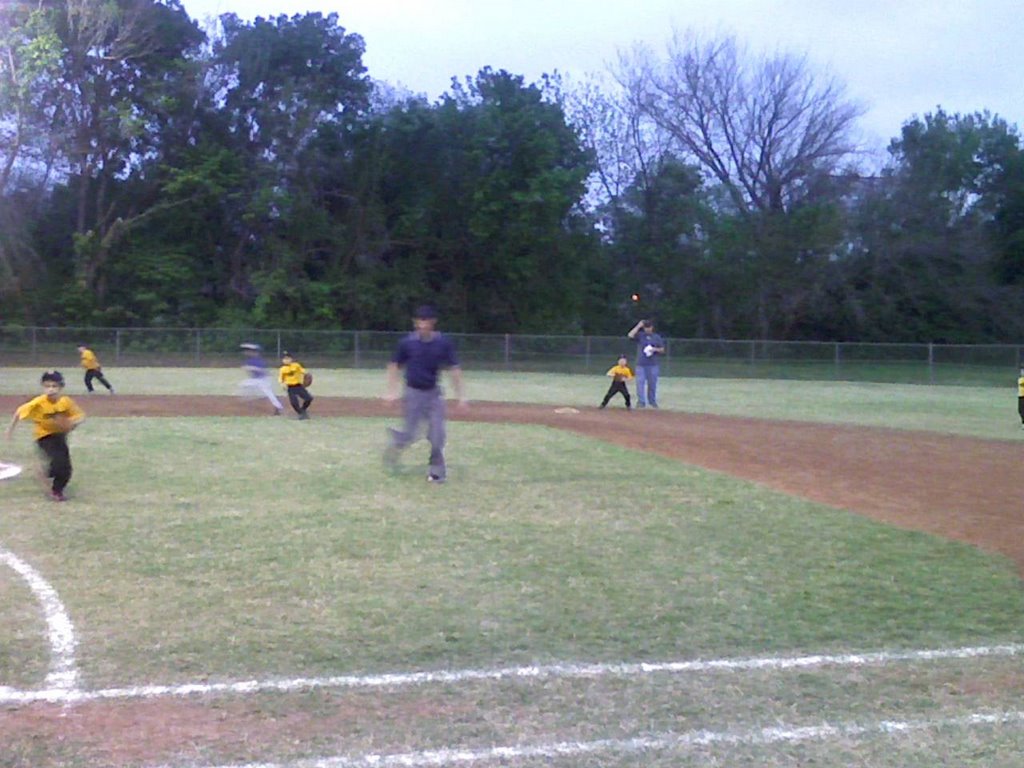
fourth from right in orange shirt... is our Andrew...


 |
| Grandma Alice’s Applesauce Cake is a 100-year-old recipe from an Oklahoma family. |
  |


"You know, the punishment has to fit the crime, so to speak," Kerry, the Democrats' defeated 2004 White House hopeful, told NY1.
Kerry, who had Imus' support in that race, said he might be willing to go on a future Imus show if the radio host finds a new station - but "if he goes back to doing the same old, same old, I'd have trouble doing that."

Quad-City barbers put down their shears and sputtered words like “preposterous” and “impossible” Wednesday when they heard of Democratic presidential candidate John Edwards spending $400 for a haircut. In the Quad-Cities, $10 or $12 is about average.
“If I charged $400 for a haircut, they’d come after me with white coats,” said Leo Fier, who has been cutting hair for 49 years at his shop in DeWitt, Iowa.
Edwards’ campaign committee filed a financial report with the Federal Election Commission noting that the White House hopeful paid $400 for haircuts in California and New Hampshire, and $248 for salon services in Dubuque, Iowa.
“That’s impossible, $400,” said Don “Dutchman” Braafhart, who runs Dutchman’s Barbershop in Davenport.
Next time he’s in town, Edwards would get a real bargain at Davenport Barber College, where supervised student barbers charge only $7.50.
Even some Quad-Citians who allow their locks to grow long are shocked by a $400 haircut.
“My Santa Claus long hair is my trademark,” said Terry Lunardi, Davenport restaurateur. “I just had my hair cut Monday for $10. And I have a lot of hair to cut.”
Kurt Ullrich, a Scott County deputy auditor whose hair runs long, said, “Edwards and I are of a similar age and I took note of his hair when I visited briefly with him in Davenport. His hair is thick, full and beautifully coiffed, whereas mine is counter-culture long. Sixteen dollars is the most I’ve ever paid for a haircut.”
There are a few Quad-City shops that rise above the $10 average. A man’s haircut may range from $18 to $42 at some specialty salons. Operators at two of those shops said they would welcome Edwards, and not charge his campaign $400.
A barbaric price for cutting hair may not be unusual. Jay Ledford, who runs Cut Rite, Moline, with his dad, Jay Sr., insists that a number of years ago, President Clinton had his hair cut in Davenport. “I can’t remember the barber, but he only charged him $150,” Ledford said.
Bill Wundram can be contacted at
(563) 383-2249 or bwundram@qctimes
 Street measures up to new record | ||
A town in Caithness is to enter the Guinness World Records for having the shortest street in the world. Ebenezer Place in Wick measures 6ft 9in and has one address, the front door of No 1 Bistro - part of Mackays Hotel. A Guinness World Records spokeswoman confirmed that Craig Glenday, the editor-in-chief of the Guinness Book of Records, visited Wick. She added that Ebenezer Place had beaten the current world record of 17ft Elgin Street in Bacup, Lancashire. 'Great interest' Mackays Hotel owner Murray Lamont said he had always been confident Ebenezer Place would set a world record. He said: "Everyone is delighted. "The street was built in 1883 and people here know about it but I decided to put it firmly on the map. It has certainly become a great point of interest." Mr Lamont said he did not know where the street's name had come from. "It could have religious or Masonic roots," he added. Ed note: the kind of things that fill my mailbox each morning.. haha.. love them! and those that send them!! thanks for taking the time! | ||
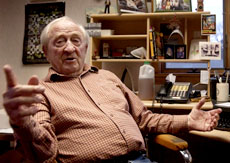
At age 81, he doesn't own a car. He performs errands and commutes to the office by bicycle.
He lives on the outskirts of Media in a narrow wood-frame house that was built for mill and factory workers.
And he has given away millions.
Given the fortune that Taussig has made through Untours, his unique travel business, and has given away through the Untours Foundation, you could call him the Un-millionaire. If he so chose, he could be living in a Main Line mansion and driving a Mercedes. But he considers money and what he calls "stuff," beyond what he needs to survive, a burden, an embarrassment.
"He really walks the talk," says Judy Wicks, owner of the White Dog Cafe and a fellow member of the Social Venture Network, which applies capital to enterprises that reduce poverty and advance social justice.
"A lot of people donate money to the less fortunate but live in high style themselves. Hal sacrifices in his own life by living very simply in order to have more money to give away."
In many respects, he's a 21st-century Thoreau. "Let your capital be simplicity and contentment," the sage of Walden Pond wrote. "Those are my sentiments precisely," says Taussig, who has three children, five grandchildren, and five great-grandchildren.
Taussig works three jobs:
He cares for Norma, his wife of 61 years, who was crippled by a stroke in 1999.
He helps run Untours, a tour-planning service that enables vacationers to experience foreign places deeply.
He directs the Untours Foundation, into which he pours all his profits - $5 million since 1992. The money is used to make low-interest loans to ventures and projects that help the needy and jobless - from a craft store in Hanoi to a home-health-care cooperative in Philadelphia.
"If capitalism is good, it should be good for the poor," Taussig declares. "I invest in entrepreneurial efforts to help poor people leverage themselves out of poverty."
As a boy, Taussig lived like a pioneer, in a log house on a cattle ranch in Colorado. His mother made his underwear from flour sacks. His Jewish grandfather married an evangelical Christian. Taussig was reared in a household where no one dare gainsay the Word of God, as plainly revealed in the Bible.
He was sent to Wheaton College in Illinois, "the Harvard of Evangelicalism," where he became a champion wrestler. Cursed by an independent mind, he balked at the story of Creation. It was preposterous, and he said so to God.
The Lord gave Taussig a pass, freeing him to craft his own faith.
"God created human beings in his own image. That is the heart of my faith," says Taussig, who now attends the First United Methodist Church of Media.
After college, Taussig returned to Colorado, where he and his brother resumed cattle ranching - and went broke.
"The cattle market took a nose-dive," Taussig says. "We invested in a sterile bull. We paid $5,700 for him, and sold him for hamburger."
Rather than feel ashamed, Taussig felt cleansed. He wanted, he says, to "own the failure."
"In America, we worship success, and making our way up, and leaving the masses behind," he says. "It's a shoddy ethic that leads us to value who we are by what we are."
In 1957, he came East to pursue a doctorate in American civilization at the University of Pennsylvania. During the day, he taught seventh grade in Upper Darby and later 11th grade in Springfield, Delaware County. After 10 years of teaching, he took a sabbatical, and drove a VW Beetle all over Europe.
Back home, Taussig wrote a book about his adventure, Shoestring Sabbatical. It inspired an idea: a travel agency that would enable tourists to get to know a place intimately by staying at least two weeks in a rented cottage, apartment or farmhouse. With a $5,000 loan from a friend, Taussig launched Untours in 1975.
"Europe is so enriching and rewarding, I decided to help others have a similar experience," he says. His ulterior motive: forging connections and understanding between people and cultures.
In the early '80s, Taussig was making more money from the tour operation than he needed or wanted. He decided to accept about $20,000 a year for his basic expenses.
First, Taussig gave the excess profits back to his customers. The next year, he split the profits among his employees. Finally, he decided to channel them into a foundation.
The motto of the Untours Foundation is "a hand up, not a handout." It provides low-interest loans, here and abroad, to create jobs, build low-income housing, and support fair-trade products: goods such as coffee that are sold at a price that guarantees producers and workers a fair wage and decent livelihood.
The loans, usually pegged to the U.S. inflation rate, range from $6,000 to $250,000. Over the last 15 years, about 50 individuals and organizations have benefited from Untours seed money. Some examples:
Along with the successes, there have been failures, but Taussig is heartened by the many ventures that have taken root, paid off their loans, and blossomed. In 1999, Untours received the Newman's Own/George Award for being "the most generous business in America." The award from Paul Newman and John F. Kennedy Jr., the late publisher of George magazine, came with a $250,000 prize, which the Taussigs donated to the foundation.
"He's authentic," says Elizabeth Killough, the foundation's associate director. "He has never tried to be famous or call attention to himself. For the first eight years, he didn't tell anyone about the foundation. It's always been very personal for him."
Taussig and his wife live on Social Security and savings from the modest wages Norma earned as a school secretary and Untours bookkeeper.
"In a world gone mad with greed, he really believes in the common good," says Bob Fishman, executive director of the nonprofit social service agency Resources for Human Development, who has worked with Taussig on several projects. "He doesn't do it to say 'I'm right and you're wrong,' but rather to show, in his own sweet way, that there's another path. By his example, he gets all of us to think, 'can't I do more?' "
Taussig does not consider himself heroic or saintly.
"This is my way of finding meaning," he says. "This is how I get joy out of life. The widening gap between the rich and poor is not sustainable. I fear there will be a violent revolution if we don't find a solution to poverty in the world."
For more about Untours and the foundation, call 888-868-6871 or go to http://go.philly.com/untours

Why do you claim that "Trust" is the key leadership competency of the new global economy?
Covey: If you look at the nature of the world today, a foundational condition in Thomas Friedman's flat world is the presence of trust. Put simply, today's increasingly global marketplace puts a premium on true collaboration, teaming, relationships and partnering, and all these interdependencies require trust. In the book I point out that partnerships based on trust outperform partnerships based on contracts. Compliance does not foster innovation, trust does. You can't sustain long-term innovation, for example, in a climate of distrust.
In issue after issue, the data is clear: high trust organizations outperform low-trust organizations. Total return to shareholders in high trust organizations is almost three times higher than the return in low trust organizations.
So we assert that trust is clearly a key competency. A competency or skill that can be learned, taught, and improved and one that talent can be screened for.
Trust is the one thing that affects everything else you're doing. It's a performance multiplier which takes your trajectory upwards, for every activity you engage in, from strategy to execution.
How do you identify a high-trust or low-trust organizations?
Covey: Trust is a powerful accelerator to performance and when trust goes up, speed also goes up while cost comes down -- producing what we call a trust dividend. How do you know if you have a high trust culture? By observing the behavior of your people. In high trust, high performance companies, we observe the following behaviors:
• Information is shared openly
• Mistakes are tolerated and encouraged as a way of learning
• The culture is innovative and creative
• People are loyal to those who are absent
• People talk straight and confront real issues
• There is real communication and real collaboration
• People share credit abundantly and openly celebrate each others' success
• There are few “meetings after the meetings”
• Transparency is a practiced value
• People are candid and authentic
• There is a high degree of accountability
• There is palpable vitality and energy—people can feel the positive momentum
Another very visible indicator is the behavior of your customers and suppliers. What is your customer churn rate? Do you have a history of long-term customer and supplier relationships? What is your reputation or brand equity in your marketplace?
Conversely, when the trust is low, there's a trust tax which changes your trajectory downwards. In our work with organizations, we find that low-trust, low-performance organizations typically exhibit cultural behaviors like:
• Facts are manipulated or distorted
• Information and knowledge are withheld and hoarded
• People spin the truth to their advantage
• Getting the credit is very important
• New ideas are openly resisted and stifled
• Mistakes are covered up or covered over
• Most people are involved in a blame game, badmouthing others
• There is an abundance of “water cooler” talk
• There are numerous “meetings after the meetings”
• There are many “undiscussables”
• People tend to over-promise and under-deliver
• There are a lot of violated expectations for which people make many excuses
• People pretend bad things aren’t happening or are in denial
• The energy level is low
• People often feel unproductive tension—sometimes even fear
These behaviors are all taxes on performance.
The work we do is to establish trust as your organizational operating system. That's a high-tech metaphor, but it's appropriate. We know how trust works, how to measure it, how to establish it, grow it, extend it, and sustain it – with all stakeholders.
Why is trust such a hidden variable to many otherwise competent managers?
Covey: Unfortunately, too many executives believe the myths about trust. Myths like how trust is soft and is merely a social virtue. The reality is that trust is hard-edged and is an economic driver.
For instance, strategy is important, but trust is the hidden variable. On paper you can have clarity around your objectives, but in a low-trust environment, your strategy won't be executed. We find the trust tax shows up in a variety of ways including fraud, bureaucracy, politics, turnover, and disengagement, where people quit mentally, but stay physically. The trust tax is real.
There are many myths about trust, and in my book I present them in a table your readers may find helpful:
| MYTH | REALITY |
| Trust is soft | Trust is hard, real, and quantifiable. It measurably affects both speed and cost |
| Trust is slow | Nothing is as fast as the speed of trust |
| Trust is built solely on integrity | Trust is a function of both character (which includes integrity) and competence |
| You either have trust or you don't | Trust can be both created and destroyed |
| Once lost, trust cannot be restored | Though difficult, in most cases, lost trust can be restored |
| You can't teach trust | Trust can be effectively taught and learned, and it can become a leverageable, strategic advantage |
| Trusting people is too risky | Not trusting people is a greater risk |
| You establish trust one person at a time | Establishing trust with the one establishes trust with the many |
So trust is measurable? quantifiable?
Covey: Absolutely, trust is measurable. Smart organizations measure trust in three key ways: 1) actual trust "levels"; 2) the "components" or dimensions that comprise trust; and 3) the "effects", or impact, of trust.
We have found that one very simple way to measure trust levels is to ask one direct question and roll it up and down throughout the organization. For internal stakeholders ask: "Do you trust your boss?" to employees at all levels of an organization. For external stakeholders, like customers or suppliers, you might ask them: "Do you trust our sales representative or account manager?" These are simple, direct questions that tell us more about our culture than perhaps any other question we might ask.
Now, wouldn't it be great if "trust" showed up on the financial statements as either a 'tax' or a 'dividend'? Organizations would then use resources to eliminate the tax or create a larger dividend! Although a high trust or low trust culture doesn't literally show up on financial statements, it does show up in the following ways, which are measurable, observable and economically relevant (all of which make a strong "business case for trust"):
| The 7 Low-Trust Organizational Taxes | The 7 High-Trust Organizational Dividends |
| 1. Redundancy | 1. Increased value |
| 2. Bureaucracy | 2. Accelerated growth |
| 3. Politics | 3. Enhanced innovation |
| 4. Disengagement | 4. Improved collaboration |
| 5. Turnover | 5. Stronger partnering |
| 6. Churn | 6. Better execution |
| 7. Fraud | 7. Heightened loyalty |
| (The opposites of the 7 Organizational Taxes are also Dividends) |
What are the competencies, the behaviors that build trust?
Covey: Trust too often has been pigeonholed as based on character and integrity alone. There's nothing wrong with that, and that is clearly the foundation, but it's insufficient.
Trust is a function of both character and competence. Of course you can't trust someone who lacks integrity, but hear this: if someone is honest but they can't perform, you're not going to trust them either. You won't trust them to get the job done.
That's one reason why trust has a soft image- because it has been severed from competence and results.
So how does one apply trust to branding?
Covey: When I look at a brand, a brand is nothing more or less than trust with the customer, trust with the marketplace. The principle behind a brand is reputation. The brand stands for a promise and the ability to deliver on that promise. And in that promise is a company's character and competence, its reputation.
From the character side you start with integrity—honesty, congruence, humility and courage. The courage to be open, to stand for something, to make and keep commitments. Then there's intent—is there a genuine concern for people, purposes and society as a whole or is profit your sole motive? What's the company's agenda? And how does it behave? Sometimes poor behavior is simply bad execution of good intent.
On the competence side, you start with your capabilities—talents, skills, the ability to deliver. Is your company staying relevant, are you continually improving, do you have the right technologies to stay ahead of your competition? Brands need to reinvent themselves from time to time to stay relevant. Finally, look at your results. Your company and your brands are constantly measured based on past performance, present performance and anticipated future performance.
These four dimensions—integrity, intent, capabilities and results—make up the credibility and reputation of your brand. When the trust is high, you get the trust dividend. Investors invest in brands people trust. Consumers buy more from companies they trust, they spend more with companies they trust, they recommend companies they trust, and they give companies they trust the benefit of the doubt when things go wrong. The list goes on and on. On the Internet, a trusted brand versus an untrusted brand—the differences could not be clearer, you only give your credit card number to those you trust. And look what happens when a brand gets diluted or polluted or compromised, we see how fast consumers, and investors, turn away. They quit buying.
These same principles apply equally to companies and individuals.
What about the social responsibility of business? Is this part of the trust equation?
Covey: Initially many companies may move into this arena for PR purposes. More out of fear of not being in the arena, than really participating with their souls. But there are huge benefits that flow from this - the difference it makes with your employees first, then your customers, your suppliers, your distributors, your investors.
The distrust we see all around is suspicion, a response to the corporate scandals and vicious downward cycles of cynicism. But when a company focuses on the principle of contribution for all stakeholders, that becomes good business. Executives need to understand the economic benefits of this trust dividend, especially when the behavior is real, not artificially or superficially created as PR to manipulate trust. We will see more and more companies moving in this direction because it makes economic sense, period.
Trust varies by geography, as you've pointed out in your book. How do companies build trust globally?
Covey: There's no question that trust issues are global issues. There's also a country tax. The Edelman Trust Barometer tells us, for example, that trust is often based on country of origin. US companies are being taxed in Europe, in Germany, France and England, for example. How can companies like UPS improve their trust rankings?
 Trust can be rebuilt. So how do you build trust? By your behavior. We've identified 13 behaviors which build trust:
1. Talk Straight
2. Demonstrate Respect
3. Create Transparency
4. Right Wrongs
5. Show Loyalty
6. Deliver Results
7. Get Better
8. Confront Reality
9. Clarify Expectations
10. Practice Accountability
11. Listen First
12. Keep Commitments
13. Extend Trust
Companies need to have a strong promise, because the promise builds hope. Keeping the promise is what builds trust.
My father has an expression: "You can't talk yourself out of a problem you behaved yourself into." So it is with trust.
Sometimes it takes a little time, but you can accelerate the process by declaring your intent and signaling your behavior, so others can see it.
People and companies can learn these behaviors. It's not a simple process which happens overnight. But it is a systemic, cultural process which can happen one leader at a time, one division at a time, one company at a time, and you can see the behavior shifting toward authentic, real trust-building behaviors as opposed to the more common counterfeit behavior of spin and hidden agendas and the like which tend to dissipate and diminish trust.
 Is there a danger in being too trusting or even gullible?
Covey: One thing about trust is that everyone's for it.
However, there are three big objections which come up. The first one is that trust is a social virtue, to which I say no, it's much more than that; it's a hard-edged economic driver. Secondly, and we hear this all the time: "we can't do anything about trust, it's either there or it's not there." This too is a fallacy. Trust is a competency. It's something you can get good at. It's a strength you personally, and your team and your company can master. Being good at it will elevate every other strength you have.
The third complaint goes along these lines: "We've been burned before. We can't trust everyone. Are you suggesting we trust everybody?" That's where I suggest you exercise what I call "SmartTrust." Most leaders have been burned before, so they become distrusting. Our society is that way. After Enron and WorldCom, we pass legislation like Sarbanes-Oxley to force compliance, raising the "tax" on all businesses. The question is, "is there a third alternative?" An alternative where you combine a high propensity to trust with good analysis and judgment, so we can really assess the circumstances, the risk, the credibility of the people involved, so we can extend trust, and build into that trust a stewardship or responsibility.
If you're not trusted, you tend to reciprocate with distrust. That's how the vicious cycle of mistrust starts and spirals downward.
There is a risk in trusting people, but the greater risk is not trusting people.
SmartTrust says you look at the opportunity, the risk and the credibility of the people involved. And you add to that verification and analysis. So you trust and verify. As opposed to verify, then trust!
Let's look at Berkshire Hathaway and Warren Buffet. I mention them in the book as an example of a high-trust company, about the acquisition they made based on a hand shake without due diligence.
But did you know that's how the entire company operates?
They have a 192,000 employees with 42 different wholly-owned companies. How many people do you think work at corporate headquarters? '
Seventeen!
Why? Because they choose to operate in a "seamless web of deserved trust" as Charlie Munger calls it.
This is real. It's not blind trust, but smart trust.
Thank you so much. I truly believe The SPEED of Trust: The One Thing that Changes Everything